

Healthcare AI · November 17, 2025 · kaddu livingstone · 6 min read
From Data to Decisions: How AI Turns Clinical Data into Better Patient Outcomes
Clinical data is growing faster than healthcare teams can manage. Curely AI explores how artificial intelligence can transform scattered patient information into real-time insights that improve care, reduce risk, and support better clinical decisions.
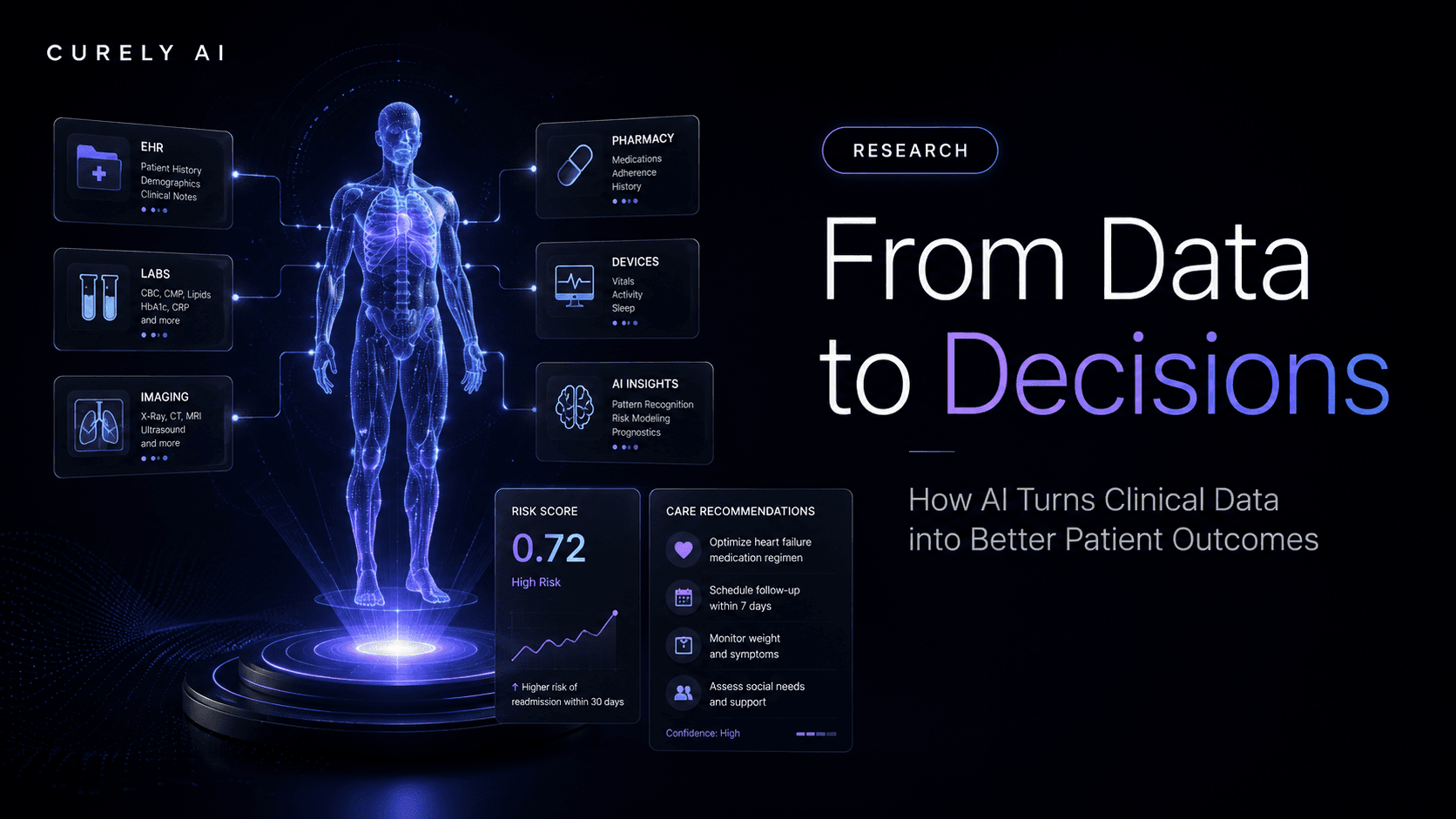
Every day, hospitals and clinics generate massive amounts of data, patient histories, lab results, clinical notes, imaging reports, medications, vital signs, appointments, billing records, and more.
But in many healthcare environments, this information remains scattered across departments, paper files, spreadsheets, legacy systems, and disconnected digital tools.
The result is simple but dangerous: healthcare teams often have data, but not intelligence.
At Curely AI, we believe the future of healthcare will be defined by how well organizations turn clinical data into real-time decisions. Artificial intelligence can help healthcare providers move beyond passive record keeping into proactive, intelligent, and patient-centered care.
The Problem: Healthcare Data Is Fragmented
A patient’s health story is rarely stored in one place.
One part may be in registration records. Another may be in laboratory results. Another may be in prescriptions. Another may be buried inside clinical notes. Another may be stored in a previous visit, a different facility, or a disconnected system.
This fragmentation creates serious challenges.
Clinicians spend valuable time searching for information instead of treating patients. Critical patterns are missed. High-risk patients are identified too late. Care teams repeat work because they cannot see the full picture. Administrators struggle to understand what is happening across the facility in real time.
In healthcare, delayed information can become delayed care.
That is why intelligent data infrastructure matters.
From Records to Intelligence
Traditional healthcare software focuses mainly on storing information. It records patients, visits, diagnoses, prescriptions, lab tests, bills, and appointments.
That is important, but it is no longer enough.
Modern healthcare systems need to understand the data they store.
AI makes this possible by analyzing patient information, recognizing patterns, detecting risk signals, and presenting meaningful insights to healthcare professionals.
Instead of only asking, “Where is the patient record?” healthcare teams can begin asking better questions:
Which patients are at higher risk?
Which care gaps need attention?
Which lab results need urgent review?
Which patients need follow-up?
Which departments are overloaded?
Which workflows are slowing down care?
This is the shift from data collection to decision intelligence.
How AI Improves Patient Outcomes
Artificial intelligence can support better patient outcomes in several practical ways.
- Better Patient Profiling
AI can help build a clearer, more complete view of each patient by connecting information from multiple sources.
This may include demographics, visits, symptoms, diagnoses, medications, lab results, allergies, clinical notes, and treatment history.
With a stronger patient profile, clinicians can understand the patient faster and make better-informed decisions.
- Earlier Risk Detection
Many health risks develop gradually before they become emergencies.
AI can help detect early warning signs by analyzing patterns across patient data. For example, changes in vital signs, repeated symptoms, abnormal lab results, missed appointments, or medication history may indicate rising risk.
When these signals are identified early, healthcare teams can intervene before the condition becomes more serious.
- Smarter Clinical Workflows
Doctors and nurses often face heavy administrative workloads. They document notes, search for records, request tests, review results, prepare prescriptions, and coordinate follow-ups.
AI can reduce this burden by helping summarize records, organize information, suggest next steps, and highlight what requires attention.
This does not replace healthcare professionals. It gives them better tools.
- Improved Continuity of Care
Patients often move between departments, providers, and facilities. Without a unified view, continuity of care becomes difficult.
AI-powered systems can help maintain a connected patient journey by linking visits, encounters, service requests, prescriptions, lab results, and follow-up plans.
This creates a more coordinated care experience.
- Better Operational Decisions
Healthcare outcomes are not only influenced by clinical decisions. They are also affected by operations.
If departments are overloaded, patients wait longer. If lab results are delayed, treatment slows down. If pharmacy stock is unavailable, care is interrupted. If billing is inefficient, the facility loses revenue.
AI can help healthcare leaders monitor operations, forecast demand, identify bottlenecks, and improve resource allocation.
Better operations lead to better care.
The Role of Curely AI
Curely AI is building AI-powered healthcare infrastructure designed to help healthcare organizations become more intelligent, connected, and efficient.
Our work focuses on turning fragmented healthcare workflows into unified digital systems supported by artificial intelligence.
This includes intelligent hospital management, patient profiling, clinical notes, telemedicine, remote care, laboratory workflows, pharmacy operations, billing, appointments, and healthcare analytics.
Our vision is not just to build software that stores data. Our vision is to build systems that help healthcare professionals understand data and act on it.
AI Should Support, Not Replace Clinicians
Healthcare is deeply human.
No algorithm can replace the compassion of a nurse, the judgment of a doctor, or the trust between a patient and a caregiver.
At Curely AI, we believe artificial intelligence should support clinical teams, not replace them.
AI should help clinicians see more clearly, work faster, reduce documentation burden, and make more informed decisions. Final clinical responsibility should remain with qualified healthcare professionals.
This human-centered approach is essential for responsible healthcare AI.
Responsible AI in Healthcare
Healthcare AI must be built with strong safeguards.
Patient data must be protected. Clinical recommendations must be explainable. Systems must be auditable. Access must be controlled. AI outputs must be reviewed responsibly. Privacy, security, and compliance must be part of the foundation, not an afterthought.
Trust is the most important currency in healthcare technology.
For AI to succeed in healthcare, patients and providers must believe that the system is secure, ethical, and clinically responsible.
Why This Matters for Africa and Emerging Markets
Many healthcare systems in Africa and emerging markets face unique challenges: limited resources, staff shortages, fragmented records, rural access gaps, and overloaded facilities.
But these challenges also create an opportunity to build smarter systems from the ground up.
Instead of copying outdated healthcare technology models, emerging markets can leap forward with cloud-ready, mobile-first, AI-powered healthcare infrastructure.
Curely AI is building with this reality in mind.
We believe intelligent healthcare systems should not be available only to the largest hospitals in the world. They should also support local clinics, growing hospitals, regional health networks, and public health programs.
The Future: Real-Time, Predictive, and Personalized Care
The future of healthcare will be more connected.
Patient records will become intelligent profiles. Clinical workflows will become AI-assisted. Hospitals will operate with real-time visibility. Doctors will have better decision support. Patients will receive more proactive care. Leaders will manage health systems with better intelligence.
This is the future Curely AI is working toward.
A future where healthcare data is not buried in systems, but transformed into insight.
A future where clinicians are supported by intelligent tools.
A future where patients receive faster, safer, and more coordinated care.
Final Word
Healthcare organizations do not need more disconnected systems. They need intelligence.
They need technology that connects data, supports clinicians, improves operations, and helps patients receive better care.
At Curely AI, we are building the bridge from data to decisions.
Because the future of healthcare will not only be digital.
It will be intelligent.
Related reading
Healthcare AI
Why Clinical AI Loses Accuracy When Moved to New Hospitals
Most clinical AI models lose accuracy when moved to a new hospital, and regulatory clearance does not measure it. What the external validation evidence shows.
ReadHealthcare AI
The Best Clinical AI Agent Finishes Fewer Than Half Its Tasks
The strongest clinical AI agent yet tested in a live EHR environment completes 46 percent of physician tasks, and reproduces only 28 percent. Three new benchmarks show why reliability, not medical knowledge, is now the constraint.
ReadHealthcare AI
Why Healthcare Falls Behind
Clinical workflows, information systems, and specialist expertise all show the same structural strain. We review what the evidence says about each bottleneck, and what remains unproven.
Read
Put it into practice
Hospital operating system
CurelyHMS
A connected hospital operating system, bed management, scheduling, supply, and revenue cycle in one intelligent layer.
ExplorePatient-centred AI
Patient Intelligence
Real-time patient profiles that surface risk, care gaps, and the right context at the right moment in care.
ExploreClinician copilot
AI Clinical Assistance
Clinician copilots for chart summarization, evidence retrieval, and documentation at the point of care.
Explore